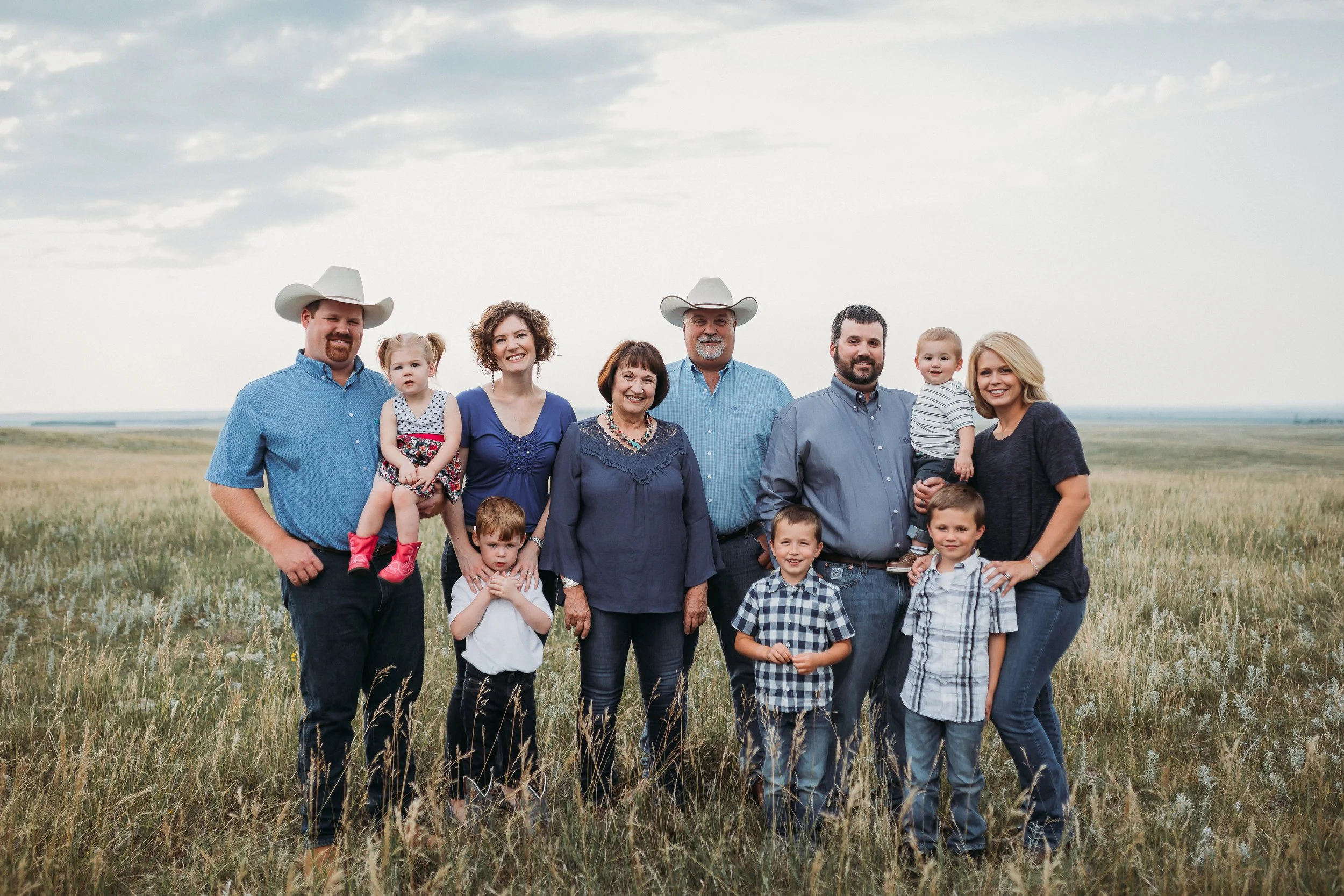
A Family Operation Since 1882
The Munger family has farmed and ranched in South Dakota since 1882, when we homesteaded in southern Brown County. Steve and Debi Munger raised their sons, AJ and Nate, on that original homestead.
In 1987, Steve put the deal together to purchase the ranch formerly known as Jennings Hyland Angus, which stretched across Hand, Hyde and Buffalo Counties in central South Dakota, and Eagle Pass Ranch was born. We were fortunate to keep most of the Jennings crew, and their experience has proven invaluable ever since. Today Steve and Debi make their home here on the ranch.
Eagle Pass is now a sixth-generation operation, with a seventh generation coming up behind. Steve and Debi remain active in the business. AJ runs the cowherd alongside his wife, Emily, and their children, Briggs and Blaire. Nate manages the farming operation with his wife, Hillary, and their sons, Rhett, Graham and Knox.
Through the Years
Plenty has changed since 1987. Our breeding philosophy hasn’t: functional cattle that improve our customers’ bottom line.
Photo Archive
Sale days, show ring wins and everyday life on the ranch, from the early years to today.
Coming Soon
1987 Stocked the ranches on the prairie of central South Dakota with a foundation herd of 4,500 commercial Angus cows.
1988 Artificially inseminated all 4,500 cows to Gelbvieh sires, the largest breed-up program ever undertaken in the U.S. The first calf crop of what would become Balancers was heavier, more uniform and more eye-appealing than any cattle we had seen. We knew from that point forward that crossbreeding would be a cornerstone of our breeding program.
1990 Began feeding out our own calves and collecting carcass data. We provided the first large-scale carcass data set to the American Gelbvieh Association, used as the base for their carcass EPDs. Steve actually spent many hours in packing plants doing tag transfers on progeny test cattle, which was required before collecting carcass data became a standard in the industry.
1992 Added registered Angus females and an aggressive embryo transfer program to complement our ongoing AI program. Cattle were sourced from the Baldridge, Scotch Cap, and Jorgenson cowherds.
1997–2007 Moderated frame size by one full score while still increasing yearling weights by 50 pounds.
2000–2019 Bred and exhibited the National Champion Balancer or Gelbvieh 14 times at the National Western Stock Show in Denver, along with 7 Reserve Grand Champions and 9 pen championships. See the past champions →
2007 Installed a GrowSafe feed intake system to measure feed efficiency on bulls and replacement females. These phenotypes provided the initial data for RFI (Residual Feed Intake) and DMI (Dry Matter Intake) EPDs for multiple breed associations. After stacking efficiency in our breeding program for multiple generations, our cowherd feed efficiency improved by 27% from our initial baseline.
2010 Started incorporating Simmental genetics into our breeding program. Building on our Angus cow base through AI and embryo transfer, we have grown one of the larger SimAngus cowherds in the country. EGL Firesteel 103F was one of the first herd sires produced from our Simmental program. In 2019 he sold for $85,000 to Lazy C Diamond, C Diamond, Schooley Cattle, Hook Farms and Clear Springs Cattle Company.
2020 After 32 years of advancing Gelbvieh and Balancer genetics, we held a total and complete dispersal of our Gelbvieh and Balancer cowherd at the ranch on November 30 to put more focus on our SimAngus herd. As Steve wrote in the sale book, “Everything in life has a beginning and an end.” Among the genetics we were proudest of was EGL Phoebe G374, one of the most prolific donors in Eagle Pass history with $500,000 in lifetime progeny sales. Her 2001 flush to SLC Freedom produced the 2002 Grand Champion female Farah, the 2003 Grand Champion female Faune and the 2002 Breeders Choice Futurity Champion Fosters.